
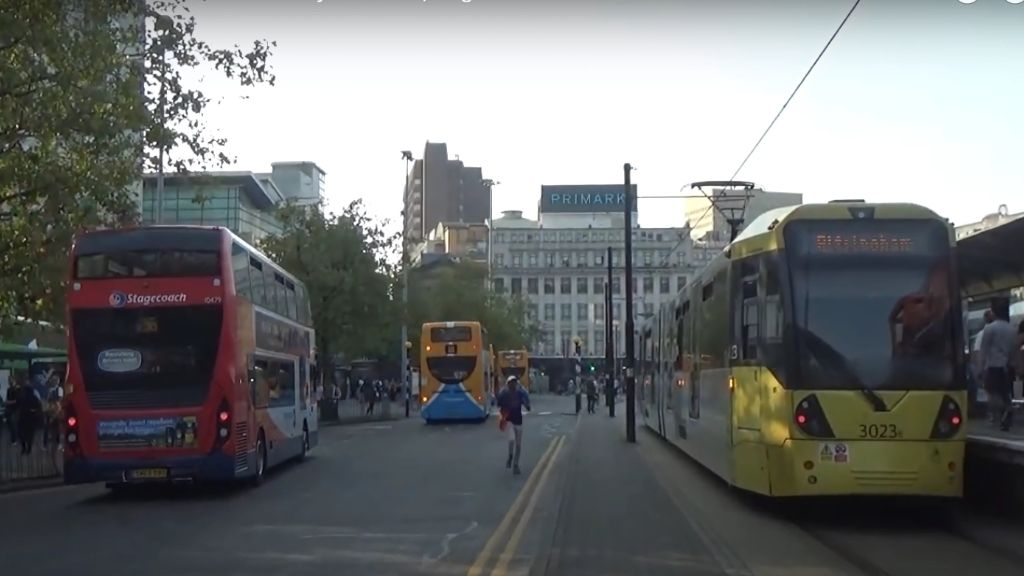
In a society that values free choice, should planners dictate how you travel? Whether by foot, bus, train, tram, or even the private car, should the decision be yours alone? Can transport networks be designed to offer genuine choice, or is competition between modes an inevitable battle with winners and losers?
The British are a funny bunch. On the one hand, we’ve built some of the greatest transport systems in the world: London’s Underground, thousands of miles of railway, all moving millions of people every day. Yet, paradoxically, we remain one of the most car-dependent nations on Earth.
The contradictions deepen when you start talking to people about their travel habits. There’s the ritualistic rail commuter, who drives to the station daily but books annual leave at the first whisper of a rail replacement service. Then there’s the savvy student, bouncing between metro and underground systems with ease, their eco-conscious, urban-chic image intact, that’s until the mere thought of boarding a bus shatters the illusion. And, of course, the hard-working backbone of society, for whom the bus is a necessity. Suggest swapping it for a train or tram, and panic immediately sets in as they wonder what a return fare might cost.
Meanwhile, in the world of transport planning, things don’t get any less absurd. Planners, desperate to justify their billion pound projects, often convince transport authorities to withdraw local bus routes, hoping, perhaps naively, that passengers will obediently transfer onto their shiny new system.
And so, the battle lines are drawn. Different transport modes, each with their own strengths, weaknesses, and fiercely loyal passengers. But is this truly a war? Or have we simply built a system where choice is an illusion, dictated by funding, planning priorities, and the whims of decision-makers?
Horses for courses
The old saying, “horses for courses” is an apt phrase for the public transport industry.
Now, I was about to say that you wouldn’t use A for B or D for C, but I didn’t. I’ve stopped myself from making the very same mistake that planners, authorities and politicians make.
Why did you stop yourself I hear you ask? Because I thought of a scenario where a passenger would chose counter to the official narrative.
A man and woman regularly travelled to Manchester by rail. At the time the trains in the North West were abysmal. Overcrowding, cancellations and late running. This unrelated couple decided to abandon the train and came to the bus station to enquire about the National Express coach service. Manchester was one stop away and tickets cost just under a tenner.
Being the helpful member of staff I suggested catching the bus to Manchester, which would save a few quid and they were more frequent.
Now here’s where it gets interesting. They weren’t just looking for an alternative to the train, they were looking for something better. The National Express coach was advertised as 15 minutes faster than the local bus, with no stops. Even though it cost more than the bus and took longer than the train, the certainty of a seat all the way to Manchester made the decision for them.
Their decision wasn’t based on cost or speed in isolation, it was about comfort, predictability, and control over their journey.

This raises an important question, do we really give people a choice in how they travel? Or do we expect them to fit into the system, rather than the system fitting around them?
Two sides of the same coin?
This story isn’t unique. Every day, passengers make similar decisions, weighing up speed, cost, comfort, and reliability; sometimes choosing what planners might call the “wrong” option. But is there really a “right” option to begin with?
Public transport often feels like a battlefield, with different modes fighting for dominance. But are they truly in competition, or are they simply different sides of the same coin each fulfilling a different role in a well-balanced network?
As startling as it maybe to some, the train, tram or tube are not necessarily the better choice when compared to the bus.
- Trains excel at speed – no bus or coach can match a two-hour journey from Manchester to London.
- Trams offer improved journey times and seamless integration between lines.
- Underground and metro systems thrive on speed, frequency, and integration.
The humble bus, by contrast, rarely competes on these criteria. Except in rare cases, it cannot match the speed or capacity of fixed-track modes. This is where planners and authorities often make a critical miscalculation. With the best of intentions, they withdraw a “competing” bus service when a new tram line is introduced, believing that doing so will encourage higher patronage on the new system. After all, funding decisions are often tied to passenger numbers, so any action that boosts figures, no matter how coercive, can seem justifiable.
This logic isn’t new. In Germany, for many years, buses and coaches were legally restricted from competing with railways. While the UK has mostly avoided such heavy-handed policies, it hasn’t been immune. When Newcastle’s Metro system was introduced, bus services were deliberately restructured to act as feeders. But the expected interchange didn’t materialise, and over time, “normal” bus services were reluctantly reinstated.
Rather than forcing passengers onto a particular mode, buses should be seen as a complement to other modes – offering real choice.
- Comfort over speed.
- Directness over journey time.
- Destinations over interchange.
Choice or control?
So, when two modes go to war, is there really a winner? Or is the real battle not between bus, tram, and train, but between choice and control?
Forcing passengers onto a particular mode doesn’t build a stronger network, it only weakens it. True success isn’t measured by whether a new tram line outperforms the bus route it replaced, but by whether the entire transport system as a whole gives people the flexibility to travel in a way that suits them.
A well-balanced network isn’t about choosing one mode over another. It’s about true integration, value to the passenger, and, most importantly, choice.
Because in the end, passengers don’t care about mode wars. They care about getting where they need to be, in the way that works best for them.
Building better networks together
By bringing real world experiences into planning, we can create better bus networks; networks that don’t just meet expectations but exceed them.
So maybe next time you’re working on a new transport project, take the time to really get to know the area and passengers and truly make the difference that we all strive for.
 Greater Buses
Leave a comment