
Integration is hailed as the holy grail of public transport planning—but is it a myth? Passengers are often left grappling with overly complex journeys, far removed from the seamless vision planners promise.

The creation of the passenger transport authorities in the 60s and 70s was supposed to integrate the public transport networks. The change to Integrated Transport Authorities in the 2000s again was meant to bring about the holy grail of integration – but didn’t.
And now in the brave new world of franchising we’re being told integration between modes is going to solve all the world’s problems. What is the reality for the passenger?
What is a journey?
There are many interpretations of what a journey consists of. From home to work. Home to the bus stop. Bus stop to the railway station. Bus stop to another random bus stop to a bus stop kind of close to where you are going, and so on, in all the many forms and variations depending on the modes chosen or worse, forced to use.
In my mind, and I suspect the vast majority of bus users’ minds, the journey is the complete whole from starting point to end point. Home to office. School to home. Doctors surgery to local supermarket.
The concept is straightforward and makes sense – but it is impossible except by walking, cycling or car. You may be the lucky one who is fortunate to have a bus stop outside of the house with a fast, frequent bus to shuttle you into the town centre where your place of work is conveniently located next to the station.
If only that could be everyone’s experience.
Instead for many people a journey will be made up of at least three legs:
- Start to stop
- Stop to stop
- Stop to end.
Or we can simplify this further as:
- Walk, bus, walk.
- Walk, train, walk (you must be really lucky!)
- Walk, tram, walk (congratulations, you live somewhere with actual investment!)
- Walk, underground/metro, walk (you’ve hit the public transport jackpot!)
Let’s break this down further to see how integration works in practice.
Taking the (sometimes) long but more connected road
The foundation of integration lies in the ability to seamlessly interchange between services and modes; whether that’s bus, rail, tram, coach, or ferry.
The benefits are clear and widely agreed upon: better access to employment and education, simpler and more direct routes, faster journey times, and more efficient use of resources.
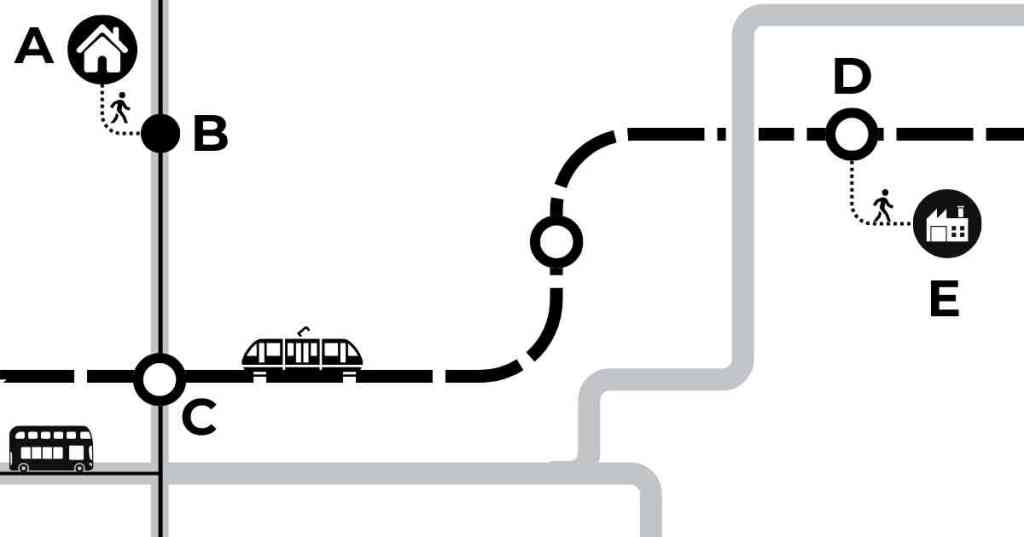
The diagram represents a typical integrated system, with a local bus network and a metro.
Joe Bloggs, living at A can travel to E via connected legs. This might be Joe’s daily commute to work across town. From A he begins his journey with a walk to his nearest bus stop B. He uses the bus to connect with the nearby metro line at C, travelling a few stops down the line to D. He alights and walks the remaining stage of his journey to work E.
This simple version of integration keeps things straightforward: fewer interchanges, shorter walking distances, and a clear route. It balances connectivity with simplicity, making it a far more appealing option for passengers.
But why does this matter? Because complexity puts people off and they will default to the easiest mode – the car. While grand integration schemes may look impressive on paper, passengers prioritise ease, directness and speed.
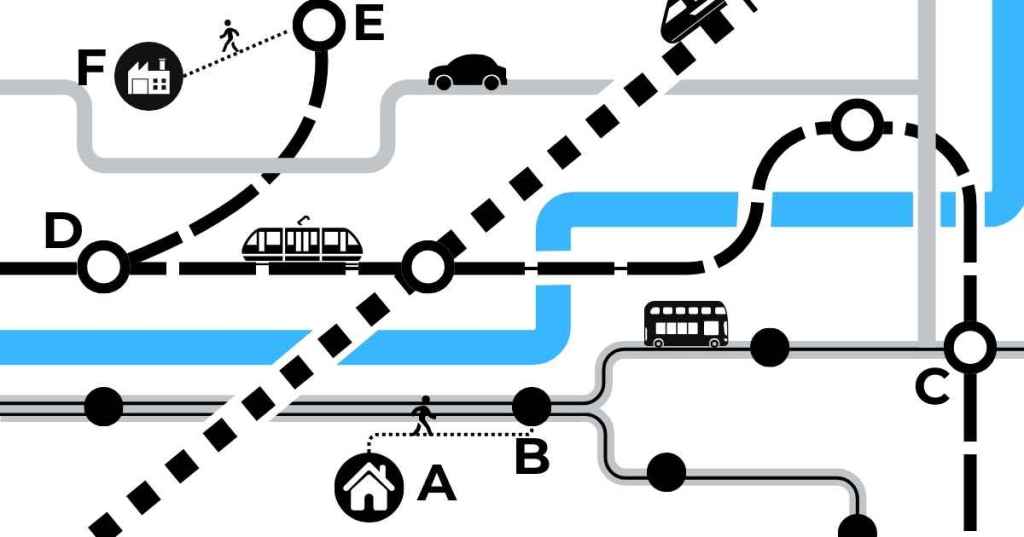
The above diagram is an extreme, complex integration scenario, but one that isn’t too far removed from the utopian ideals of transport planners.
Let’s follow Joe again and see how he fares.
Joe starts at home A and needs to get to F, his workplace. The most direct solution? A bus that runs along the main road, ideally stopping close to both his home and workplace. Simple, efficient, and accessible.
But in this over-integrated network, Joe is expected to:
- Walk to B to catch the bus.
- Change to a metro line at C.
- Change onto another metro line at D.
- Alight at E and walk to his workplace.
All this, just to reach F.
Instead of creating a seamless journey, this approach forces unnecessary complexity and makes public transport less appealing. The time wasted in interchanges and the added mental load of navigating multiple legs often push passengers toward private car use – a far cry from the goals of integration.
A system that forces multiple unnecessary interchanges risks driving people away from public transport entirely.
By designing routes that minimise interchanges and prioritise direct connections to key destinations, we can achieve a better balance, one that truly serves the needs of the passenger.
6 Tips for a successful integrated network
The idyllic, utopian integrated vision requires enormous investment, not just in physical infrastructure like vehicles, tracks, and stations, but also in staffing, technology, real-time information, and, perhaps most crucially, the political and corporate will to make it happen.
But there are things planners on both sides can be doing to build successful, integrated networks:
- Understand the passenger experience: Create passenger personas for the different areas of the network and follow their experiences to key destinations, within and outside the current and future network.
- Transport modes should complement each other: Transport modes should not compete, nor replace each other. Passengers may have a valid reason for their preference for a bus service over a rail service e.g. accessibility.
- Committed integration: If a bus service is to connect with rail, make sure it can and considers passengers travelling in both directions at different times of day. (I will cover bus/rail integration in a future edition).
- Integrated ticketing: Passengers must be able to purchase a ticket on the first service and use it all the way to the end of their journey. Increasing the number of payment transactions increases the interchange burden.
- Clear, sensible interchange points: Interchanging passengers must have the ability to interchange at clearly branded, designated, interchange points that make sense with easy to use facilities such as real-time information, maps and onward signposting. Expecting a passenger to interchange modes at a simple stop on a street out of town, increases interchange anxiety and push them away from future use.
- Frequency and reliability: The integrated network needs to be frequent, reliable and regular to reduce the interchange burden. Transferring from a high frequency service to an hourly or two hourly service, or vice versa, depletes the passenger’s goodwill reserve and will only dissuade them from considering public transport in the future.
Building Better Networks Together
By bringing real world experiences into planning, we can create bus networks that stand the test of time; networks that don’t just meet expectations but exceed them.
So maybe next time you’re working on a new transport project, take the time to really get to know the area and passengers and truly make that generational difference that we all strive for.
 Greater Buses
Leave a comment